
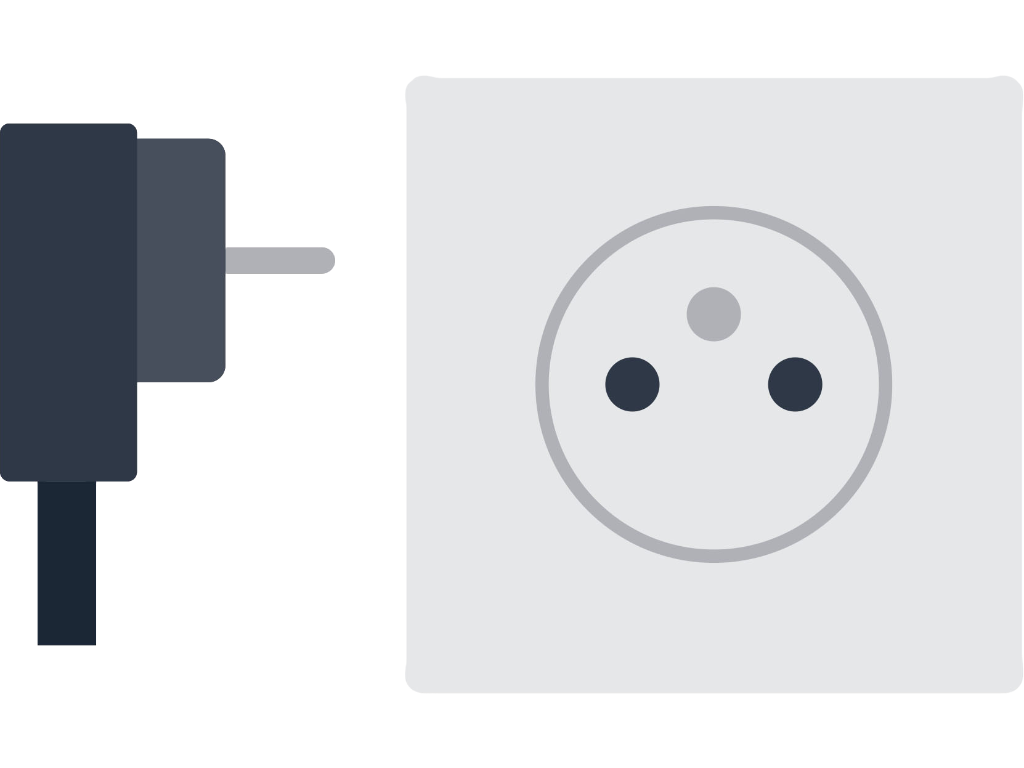
Can I use my devices in Tunisia?
The local supply in Tunisia is 230 V / 50 Hz. Most modern chargers for phones, laptops, cameras are dual voltage and work worldwide as long as the plug fits the socket.
- OKAY Phone, tablet, camera chargers and power banks usually support 100–240 V and can be used safely with the correct plug or adapter.
- CAUTION Laptops, game consoles and monitors often work worldwide, but always check the voltage range (100–240 V) on the power brick before plugging in.
- AVOID Single-voltage devices with heating elements (hair dryers, straighteners, kettles) can be problematic if their rated voltage does not match the local supply of 230 V.
Tunisia offers a compact introduction to North Africa, with the ancient ruins of Carthage, the medinas of Tunis and Kairouan, Saharan dunes in the south and Mediterranean beaches along the east coast.
There, the main plug types C and E are used and the standard supply is 230 V at 50 Hz. You will need a travel adapter because the local plug types differ from those used in your home country. Most modern devices support 100–240 V.
Tip Tunisia uses type C and E sockets. Standard European round-pin plugs fit type E sockets, so travelers already carrying a European adapter will have no issues. Visitors from the UK, North America or Australia should bring a dedicated European-style adapter.
Frequently asked questions
Do I need a travel adapter in Tunisia?
Yes, a travel adapter is necessary, because in Tunisia the common socket types are Type C and Type E.
Can I charge my smartphone in Tunisia?
Yes, you can usually charge your smartphone without any problems, because most phone chargers support a wide voltage and frequency range. A travel adapter is usually not necessary for a standard two-pin charger plug.
Which travel adapters are recommended for Tunisia?
If you are traveling to more than one country, we recommend a universal travel adapter. Good options are World Adapter 1 and World Adapter 2.